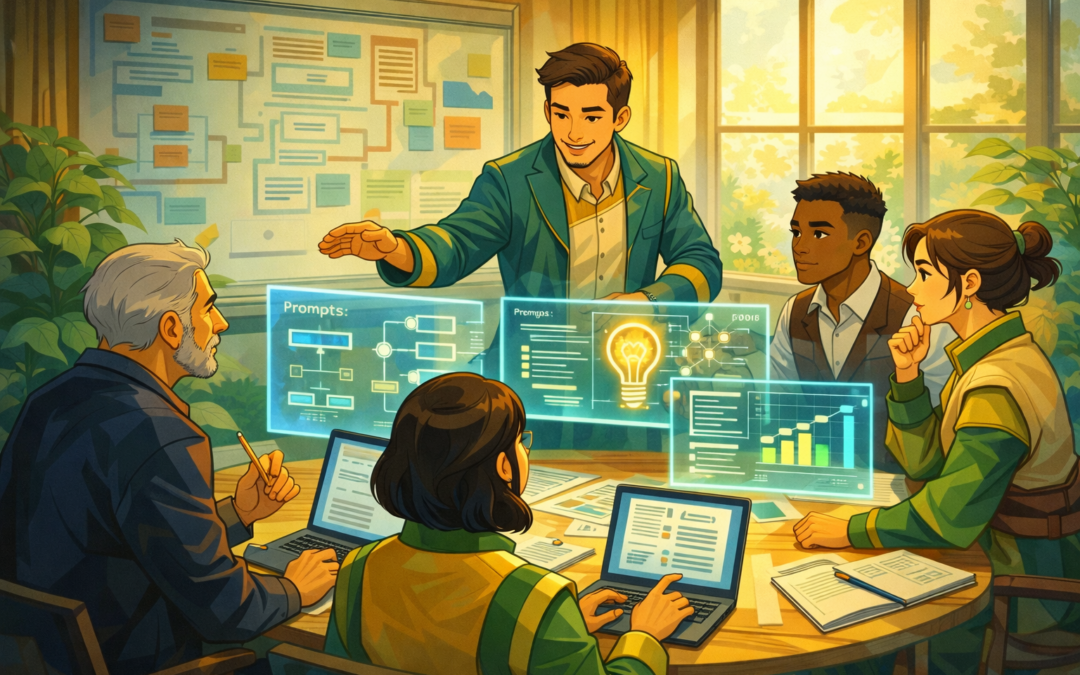
There is a unique challenge with AI for managers: they need to lead teams through AI adoption while developing their own capabilities. This page covers what managers need to know about AI in 2026.
The Challenge of AI for Managers
As a manager, you’re responsible for:
- Team productivity and output quality
- Skill development and career growth
- Process and workflow efficiency
- Appropriate use of organizational resources
AI affects all of these. Whether you adopt it deliberately or let it happen organically, AI is reshaping how your team works.
What Managers Need to Know
AI Is Already in Your Team
Your team members are probably using AI, whether officially sanctioned or not. Studies show significant “shadow AI” use across organizations.
Questions to consider:
- Do you know who on your team uses AI?
- For what tasks?
- With what data?
- Following what guidelines?
Pretending AI isn’t happening doesn’t make it safer.
AI for Managers Changes What You Can Expect
With AI assistance, reasonable expectations shift:
- First drafts come faster
- Research can be deeper
- Documentation can be more thorough
- Repetitive work takes less time
Managers need to recalibrate expectations — both for what’s possible and for how long tasks should take.
Skills Matter More Than Tools
The teams that benefit most from AI aren’t the ones with the most tools — they’re the ones with the best AI literacy.
Your priority should be building capability, not just providing access.
Leading AI Adoption
Start With Purpose
Don’t adopt AI because it’s trendy. Start with:
- What problems does your team face?
- Where do bottlenecks occur?
- What tasks feel like poor use of your team’s skills?
Then explore how AI might help.
Model the Behavior
Your team watches what you do more than what you say. If you want AI adoption:
- Use AI yourself, visibly
- Share what you’re learning
- Ask for help when you’re stuck
- Acknowledge when AI doesn’t work well
Create Psychological Safety
AI adoption requires experimentation, and experimentation includes failure. Make it safe to:
- Try new approaches
- Report when AI doesn’t work
- Ask “stupid questions”
- Share concerns about AI
Fear kills learning.
Set Clear Guidelines
Teams need clarity on:
- What’s encouraged, allowed, and prohibited
- Data that can and can’t be shared with AI
- Disclosure expectations for AI-assisted work
- How to handle AI errors
Clear guidelines enable confident use.
AI for Managers can Build Team Capability
Structured Training
Ad-hoc learning is slow and inconsistent. Consider:
- Dedicated training time for AI skills
- AI training for teams programs
- Shared resources and learning materials
- Regular skill-sharing sessions
Investment in learning pays off in capability.
Shared Best Practices
As your team learns, capture what works:
- Prompts that produce good results
- Workflows that integrate AI well
- Common mistakes to avoid
- Decision criteria for when to use AI
A shared knowledge base accelerates everyone’s learning.
Designate Champions
Identify team members who are AI-enthusiastic and capable. They can:
- Help colleagues who are stuck
- Share new techniques and discoveries
- Contribute to best practice documentation
- Provide informal training
Champions extend your capacity to support AI adoption.
Managing Risks of AI for Managers
Quality Control
AI makes errors confidently. Build verification into workflows:
- Review processes for AI-assisted work
- Clear accountability for output quality
- Sampling and auditing for high-volume use
- Easy reporting when AI errors slip through
The manager’s job isn’t to use AI perfectly — it’s to ensure the team’s AI use produces reliable results.
Ethical Use
Establish expectations for responsible AI use:
- Transparency about AI involvement
- Verification of AI outputs
- Protection of confidential information
- Fairness and bias awareness
See AI ethics at work for detailed guidance.
Dependency and Skill Maintenance
Watch for over-reliance on AI:
- Skills atrophying from disuse
- Inability to work when AI is unavailable
- Reduced critical thinking
- Loss of domain knowledge
AI should amplify human capability, not replace it entirely.
 What AI for Managers Should Be Able to Do
Effective managers in AI-enabled teams should:
- Use AI themselves — Not necessarily expertly, but competently
- Evaluate AI outputs — Recognize when something’s off
- Set appropriate expectations — For AI-assisted work
- Coach AI use — Help team members improve
- Make tool decisions — What to adopt and why
- Manage risk — Quality, ethics, security
This is the emerging skill set of AI operators at the management level.
Developing Your Own Capability with AI for Managers
As a manager, you need to learn too:
- Practice with AI yourself — Daily use for your own work
- Stay current — AI capabilities change quickly
- Learn from your team — They may know things you don’t
- Connect with other managers — Share experiences and approaches
The AI Coaching Academy provides community and structured learning for managers navigating AI.
The Bottom Line
Your job as a manager isn’t to become an AI expert. It’s to:
- Ensure AI enhances your team’s performance
- Build sustainable AI capability
- Manage the risks appropriately
- Keep humans in charge of outcomes
AI is a tool. Tools serve human purposes. Managers ensure the purposes stay human.
Leading a team through AI adoption? The AI Coaching Academy helps managers build the capability and confidence to guide AI-enabled teams.